
VAT – from emergency decree to a multi-billion tax

What began in 1941 as an extraordinary measure to finance the consequences of the war is today one of the Confederation's most important sources of revenue. The history of value added tax shows how a temporary tax became a permanent burden on consumers and businesses.
Anyone who goes shopping, eats in a restaurant, hires a tradesman or uses a service almost always pays it: value added tax. For most people it has become a matter of course – and that is precisely why it is worth taking a look at its history.
For today's VAT is still relatively young. Its predecessor, the turnover tax on goods (WUST), was introduced in 1941 during the Second World War. Switzerland was facing enormous financial challenges at the time. Military spending had risen sharply, and at the same time the Confederation needed additional funds to support struggling sectors of the economy. The Federal Council saw the balance of the ordinary budget at risk.
The WUST was therefore designed as a temporary "deficit tax". It was meant to help cope with extraordinary financial burdens. But the tax, originally intended as a transitional solution, became a permanent source of revenue for the Confederation.
The road to modern VAT
As the economy developed, the turnover tax increasingly reached its limits. It taxed goods, while services were only inadequately covered. At the same time, the system could lead to multiple taxation along the production and trading stages.
In the 1970s, an intense debate therefore began on a fundamental reform. An expert commission presented its final report in 1974. Politically, however, the introduction of a value added tax was controversial. Three proposals were rejected at the ballot box in 1977, 1979 and 1991.
It was not until 28 November 1993 that the people and the cantons approved the introduction of VAT. It finally came into force on 1 January 1995, replacing the turnover tax.
The new system brought significant changes. VAT is in principle levied on the consumption of goods and services. Businesses can deduct the tax paid on their inputs as input tax. This is intended to prevent the tax from accumulating at every stage of production and trade.
The original standard rate was 6.5 per cent and the reduced rate 2 per cent. A special rate for accommodation services was introduced later.
A tax that kept on growing
The introduction of VAT was by no means the end of the development of tax rates. On the contrary: in the following decades, the tax was adjusted and raised several times.
In 1999, the standard rate was raised by one percentage point to 7.5 per cent to finance old-age and disability insurance (AHV and IV). Further adjustments followed, among other things to finance major railway projects and disability insurance. In the meantime the standard rate rose to 8.0 per cent before being lowered to 7.7 per cent in 2018. The most recent increase took effect on 1 January 2024: the standard rate rose from 7.7 to 8.1 per cent, the reduced rate from 2.5 to 2.6 per cent and the special rate for accommodation from 3.7 to 3.8 per cent. The standard rate has thus risen by almost a quarter since VAT was introduced.
Who bears the tax?
VAT is a consumption tax. Businesses collect it from their customers and pay it to the Confederation. Economically, it is ultimately borne in principle by consumers.
This is what makes VAT so attractive to the state: it reaches a very broad section of the population and generates considerable revenue. Today it is the Confederation's second most important source of revenue.
From the point of view of the BDS, it is precisely this broad effect that should be viewed critically. For VAT is due on consumption – regardless of whether someone has a high or a modest income. Anyone who has to spend most of their income on everyday living can hardly avoid it.
On top of this comes the administrative burden. Businesses have to record, account for and document the tax correctly. For smaller businesses in particular, this means additional work and costs.
The myth of the "small" tax increase
When VAT is raised, the argument is often made with small percentages. The difference between 7.7 and 8.1 percentage points sounds modest at first. In reality, however, the burden on consumption has increased.
Nor should it be forgotten that VAT is only one of numerous levies, fees and taxes that citizens and businesses pay. For the individual, a single increase may seem small. Taken together, however, the burden keeps growing.
At the same time, the state benefits from growing economic output and rising consumer spending. A higher tax ratio thus quickly becomes a self-reinforcing system: more revenue enables higher spending, and higher spending creates political pressure for additional revenue.
No further VAT increases at the expense of taxpayers
The Taxpayers' Association (Bund der Steuerzahler) therefore opposes further increases in VAT. Before the state demands additional billions from taxpayers, it must review its own spending. A tax increase must not become the easiest way to solve structural problems in the federal budget. Anyone who calls for additional revenue must first explain why the existing funds are not enough and where savings can be made.
The history of VAT in particular offers an important lesson here: what was introduced as a temporary tax to cope with an extraordinary crisis can, within a few decades, turn into a permanent burden of billions.
The state must not get used to rising spending being automatically financed by higher taxes. Responsible fiscal policy starts on the spending side.
For the BDS, the rule is therefore: do not raise taxes first, but review spending first. Do not keep tapping new sources of revenue, but set priorities. And do not regard every additional item of public spending as unavoidable.
VAT may be a central source of revenue for the Confederation today. That is precisely why it needs a clear limit. The solution to a spending problem cannot always be a heavier burden on taxpayers.
Box: Why is VAT lower in Switzerland than in the EU?
VAT rates in the European Union are in some cases significantly higher. One reason is that the EU prescribes a minimum rate of 15 per cent. The lowest rate in the EU is Luxembourg's at 16 per cent, the highest Hungary's at 27 per cent. The EU-wide average is 22 per cent.
Another reason for the comparatively low rate in Switzerland is fiscal restraint. The debt brake prevents excessive spending and enforces budgetary discipline. Nor can VAT simply be raised: as a constitutional amendment, every tax increase must be approved by the voters. To do so, politicians must give compelling reasons to convince voters to accept an increase in tax rates.
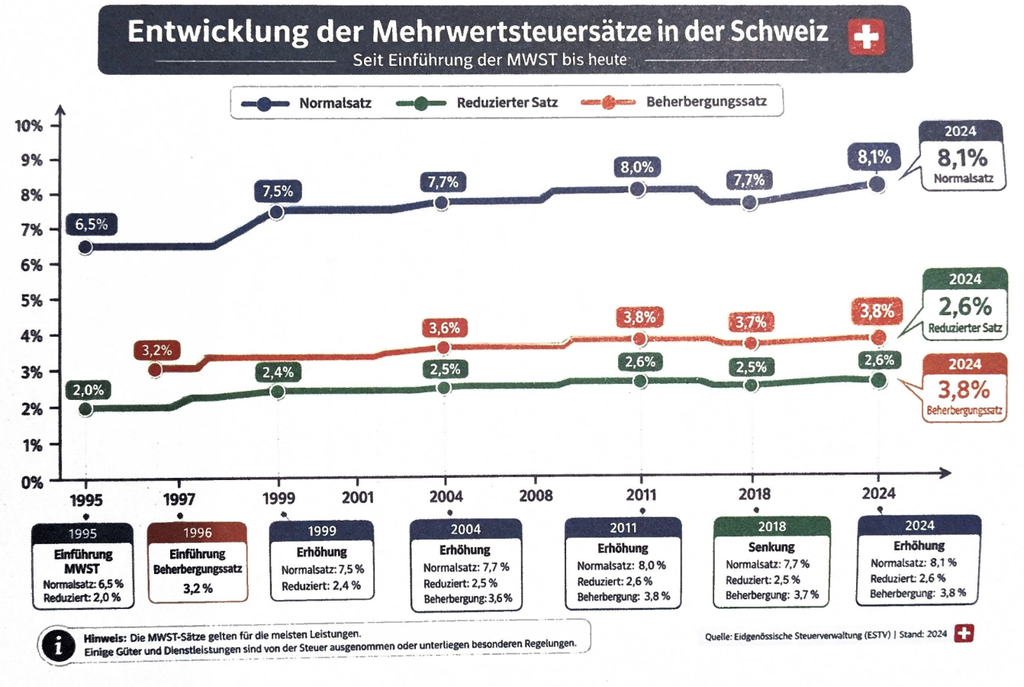
Chart: Development of VAT rates in Switzerland (since VAT was introduced)
| Year | Event | Standard rate | Reduced | Accommodation |
|---|---|---|---|---|
| 1995 | Introduction of VAT | 6.5 % | 2.0 % | – |
| 1996 | Introduction of accommodation rate | – | – | 3.2 % |
| 1999 | Increase | 7.5 % | 2.4 % | – |
| 2004 | Increase | 7.7 % | 2.5 % | 3.6 % |
| 2011 | Increase | 8.0 % | 2.6 % | 3.8 % |
| 2018 | Reduction | 7.7 % | 2.5 % | 3.7 % |
| 2024 | Increase | 8.1 % | 2.6 % | 3.8 % |
Note: The VAT rates apply to most services. Some goods and services are exempt from the tax or subject to special rules.
Source: Federal Tax Administration (FTA) | As of: 2024
Source – courtesy of / imprint: Das Steuerzahler-Bulletin, September 2026 issue. Bund der Steuerzahler BDS, 8000 Zurich. Layout: Optinovum GmbH, 3018 Bern. Printing: Coloroffset AG, 3012 Bern. Images/graphics: unsplash.com, AI
Comment by Robert Nef on financing the AHV through VAT
Careless collective pseudo-provision
In connection with the vote on financing the 13th AHV pension, the fundamental problem is being kept quiet: the pay-as-you-go system at the expense of future generations in the face of falling birth rates. It is a dangerous form of collectively suppressing scarcity, and it calls into question a socio-cultural tradition that has been deeply rooted for thousands of years: our children should one day be at least as well off as we have been – and, if possible, better. This aspiration, as a "principle of hope", can be traced almost without gaps throughout human history among peoples all over the globe. Careful stewardship of what is inherited and one's own is therefore a handed-down cultural asset. It is based on a concern for sustainability on the one hand and on a socio-cultural, cross-generational capacity for collective learning on the other.
Pushing unsolved problems onto future generations and passing on mountains of collective debt through the state is the exact opposite. Put mildly, it can be called the principle of "peace for our time"; more bluntly, "après nous le déluge" – after us, the flood. This questionable "problem non-solving procedure" of collectively postponing unwelcome outcomes is of more recent date. It is characteristic of the uncontrolled redistributive state, which paradoxically calls itself a provider of public welfare, even though its provision is based on barely controlled borrowing at the expense of future generations.
Robert Nef